
Why Filing a Police Report Is One of the Most Important Steps You Can Take

If you’ve been involved in a car accident, slip and fall, or any incident that caused you injury, filing a police report isn’t just paperwork. It’s the foundation of your entire injury claim. At Dr. Ted Injury Law, we’ve seen firsthand how the presence or absence of a police report can be the difference between a strong case and a dismissed one.

A police report creates an official, contemporaneous record of what happened. It documents the scene, identifies the parties involved, captures witness information, and often includes the responding officer’s initial observations about fault and contributing factors. Insurance companies take these reports seriously. So do judges and juries.

Whether you were hurt in South Carolina, Georgia, or North Carolina, understanding how to properly file a police report, and what to do with it afterward, puts you in a much stronger position to recover the compensation you deserve. This guide walks you through the process in each state, so you know exactly what to expect.

Request Your Free Police Report
Getting your police report should not cost you anything out of pocket.

At Dr. Ted Injury Law, we cover the cost of obtaining your official accident report so you can focus on your recovery instead of paperwork. Just reach out to our team and we will take care of pulling the report on your behalf, at no charge to you, as part of our commitment to making the claims process as simple as possible for our clients.

May Dr. Ted Injury Law Contact You Via SMS/Text Message?

Police car with lights on

What a Police Report Contains and Why Every Detail Matters

Before diving into state-specific steps, it’s worth understanding what police reports actually include. While the exact form varies by state, most accident and incident reports capture:

  • Identifying Information: Names, addresses, driver’s license numbers, and insurance details for all parties involved. Errors here can create problems with insurance claims, so review these entries carefully.
  • Vehicle Information: License plate numbers, vehicle identification numbers (VINs), make, model, and year of any vehicles involved.
  • Accident Details: Date, time, and precise location of the incident. Road and weather conditions at the time.
  • Officer’s Narrative: A written account of how the responding officer believes the incident occurred, based on physical evidence and witness statements.
  • Fault Indicators and Citations: Whether any citations were issued, and whether the officer noted contributing factors like speeding, distracted driving, or failure to yield.
  • Diagram of the Scene: Many reports include a rough sketch showing vehicle positions, directions of travel, and point of impact.

Any inaccuracy in these fields, such as a wrong address, an incorrect description of how the crash happened, or a misattributed citation, can complicate your injury claim. One of the first things the legal team at Dr. Ted Injury Law does when reviewing a new case is pull the police report and scrutinize every line.

NC Reporting Requirements

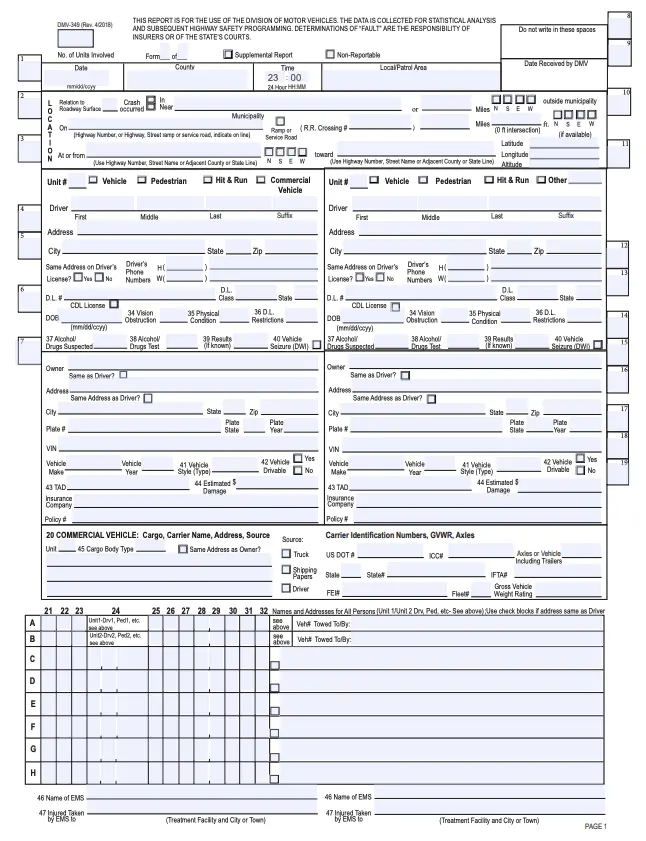
North Carolina requires reporting of any accident that results in injury, death, or property damage of $1,000 or more. Officers responding to qualifying accidents will complete a crash report using the DMV-349 form, which is the standard vehicle crash report used statewide. Like South Carolina and Georgia, if no officer responds to a qualifying accident, you must self-report.

How to Get Your NC Crash Report

  • Online via NC DMV: The North Carolina Division of Motor Vehicles allows individuals to request crash reports online. You’ll need identifying details about the incident.
  • Directly from the Responding Agency: The local police department or NC State Highway Patrol office that filed the report can provide a copy, typically for a small fee.
  • Through Your Attorney: Dr. Ted Injury Law can request and obtain your DMV-349 on your behalf and walk you through exactly what it says.

Reports are generally available 5–10 business days after the incident.

Understanding the NC DMV-349 Form

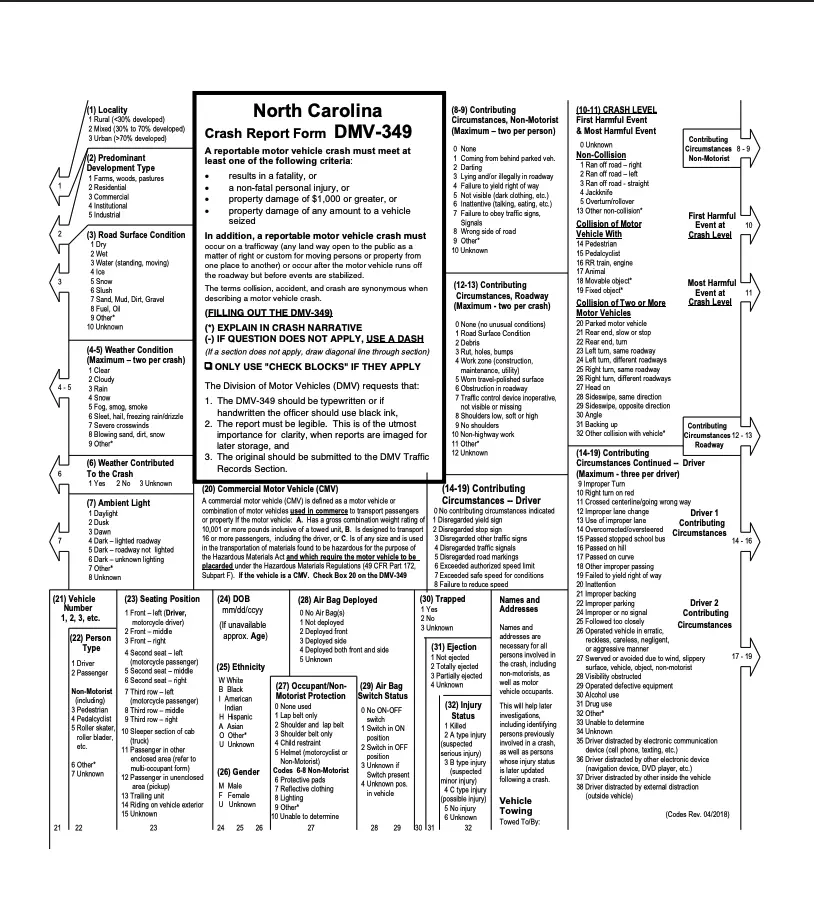
The DMV-349 is the official North Carolina crash report form. It is comprehensive and coded, which can make it difficult to read without guidance. The form captures:

  • Crash type and severity
  • Driver and vehicle information for all parties
  • Insurance company and policy details
  • Road and environmental conditions
  • Officer-assigned contributing circumstances (such as distracted driving, DUI, or failure to yield)
  • A diagram of the crash scene
  • Injury classifications for each person involved

Each contributing circumstance is represented by a numerical code. These codes matter. They indicate what the officer believed caused or contributed to the crash. Code 01 might mean “driver inattention,” while another code might indicate a mechanical defect. Understanding these codes is essential to evaluating how the report will affect your claim.

NC Contributory Negligence: Why Your Report Is Even More Critical Here

North Carolina is one of only a handful of states that still follows pure contributory negligence. This is a significant legal distinction. Under contributory negligence, if you are found to be even 1% at fault for the accident, you may be completely barred from recovering any damages.

This makes the police report, and specifically how fault and contributing circumstances are recorded, extremely consequential in North Carolina injury cases. If the officer notes even a minor contributing factor on your part, an insurance company can use that to deny your claim entirely.

If you’ve been injured in North Carolina and there’s anything in the police report that suggests even partial fault on your side, contact Dr. Ted Injury Law before speaking to any insurance adjuster. What you say, and what’s in that report, can permanently affect your right to recover.

When Are You Required to Report an Accident in SC?

In South Carolina, state law requires you to report any accident that involves injury, death, or property damage exceeding $1,000. Given today’s vehicle repair costs, that threshold is crossed in almost every collision.

If law enforcement responds to the scene, the officer will typically complete the report. However, if police do not respond, such as in a minor fender-bender in a private parking lot, you may still need to file your own report.

How to Obtain Your SC Police Report

There are a few ways to get a copy of your South Carolina collision report:

  • Online: The SCDMV’s online portal allows you to search and purchase copies of collision reports. You’ll need the date of the accident, the county where it occurred, and one of the parties’ names or driver’s license numbers.
  • In Person: Visit the law enforcement agency that responded to the scene (local police department or county sheriff’s office) and request a copy. Bring your ID and the accident date.
  • By Mail: Some agencies allow written requests accompanied by a small processing fee.

Reports typically take 5–10 business days to become available after the incident.

The SC Traffic Collision Report (Form FR-10)

South Carolina uses the FR-10 form for accident reporting. When officers respond to a scene, they complete a full traffic collision report through the SC Department of Motor Vehicles (SCDMV). This report becomes part of the official record and is available to you, your attorney, and insurance companies.

If you need to self-report because law enforcement did not respond, you can complete the FR-10 form yourself and submit it to SCDMV within 15 days of the accident.

What to Do If Your SC Report Contains Errors

Officers are human, and mistakes happen. If you review your South Carolina collision report and find inaccuracies such as a wrong driver’s license number, an incorrect description of the crash, or missing witness information, contact the law enforcement agency that filed the report and request a supplemental amendment.

If the error affects fault determination or your ability to file a claim, contact Dr. Ted Injury Law immediately. We can help you navigate the correction process and protect the integrity of your case.

SC-Specific Considerations: Comparative Fault

South Carolina follows a modified comparative fault rule. This means that if you are found to be 51% or more at fault for the accident, you cannot recover damages. If you’re less than 51% at fault, your recovery is reduced proportionally. The police report’s fault indicators and officer narrative can directly influence how fault is allocated, which is why accuracy is critical.

When Must You Report an Accident in Georgia?

Georgia law requires you to report any accident involving injury, death, or property damage of $500 or more to local law enforcement or the Georgia State Patrol. In practice, if anyone is hurt or if vehicles need to be towed, you should always call 911 and ensure a report is filed.

If a law enforcement officer responds to the scene, they will complete a Georgia Uniform Motor Vehicle Accident Report. If you are involved in an accident where police do not respond, you are still responsible for reporting it yourself.

How to Get Your Georgia Accident Report

  • Online via Open Records: The Georgia Department of Transportation maintains an online portal where you can request traffic accident reports. You’ll need basic information about the incident to locate the right file.
  • Through the Responding Agency: If local police or the Georgia State Patrol responded to the scene, contact that agency directly with your incident information.
  • Through Your Attorney: If you’ve retained Dr. Ted Injury Law, we can obtain the report on your behalf and review it for issues before you even see it.

Reports are usually available within 5–7 business days of the incident.

The Georgia Uniform Motor Vehicle Accident Report

Georgia uses a standardized form called the Georgia Uniform Motor Vehicle Accident Report. This document captures all of the key details of the collision and is submitted through the Georgia Department of Transportation (GDOT) and the Georgia Department of Driver Services (DDS).
Example police report for GA

This report is distinct from a simple incident report. It’s a state-standardized form used by every law enforcement agency in Georgia, making it easier to access and interpret.

Self-Reporting in Georgia

If you’re involved in an accident where no officer responds and the damage or injury meets reporting thresholds, you can file a Driver’s Report of Accident (SR-13) directly with the Georgia Department of Driver Services. This is your responsibility, not just an option.

Failing to report a qualifying accident in Georgia can result in license suspension and other legal consequences.

Georgia’s Comparative Fault Rules

Georgia also follows a modified comparative fault system, but with a 50% threshold. If you are found to be 50% or more at fault, you recover nothing. Below that threshold, your damages are reduced by your percentage of fault. Again, what’s recorded in the police report, and how fault is characterized, can have a direct financial impact on your injury case.


Common Mistakes People Make When Filing or Reading a Police Report

Across all three states, we see the same preventable errors come up again and again. Here’s what to watch for:

  • Not calling the police at the scene. Even if an accident seems minor, always call 911. Injuries aren’t always immediately apparent, and without a report, your claim has no official foundation.
  • Admitting fault at the scene. Adrenaline and shock can cause you to apologize or make statements that later get recorded in the police narrative as admissions of fault. Never say “I’m sorry” or speculate about what you did wrong. Stick to facts.
  • Not reviewing the report promptly. Reports can contain errors. The sooner you review yours, the sooner you can take action to correct mistakes before they cause damage to your claim.
  • Assuming the officer’s fault determination is final. The officer’s assessment carries weight, but it is not the final word. An experienced injury attorney can challenge, supplement, or contextualize the report with additional evidence.
  • Not gathering your own documentation. Even after a report is filed, document everything yourself: photos of the scene, your injuries, vehicle damage, and contact information for any witnesses.

How Dr. Ted Injury Law Uses Your Police Report to Build Your Case

At Dr. Ted Injury Law, the police report is one of the first documents we request in any new case. Here’s how we use it:

We verify every piece of identifying information, including driver’s license numbers, VINs, and insurance details, to ensure there are no errors that could complicate your claim. We scrutinize the officer’s contributing circumstances and narrative for any characterization that doesn’t match the evidence. We compare the scene diagram with photos and physical evidence. We cross-reference witness statements recorded in the report with what those witnesses actually told us. And where the report is incomplete, inaccurate, or misleading, we build supplemental evidence to tell the full story.

A police report is a starting point, not an ending point. It’s our job to make sure your case is built on accurate, complete information, and that nothing in that report is used unfairly against you.

Get a Free Case Review and Police Report from Dr. Ted Injury Law Today

If you’ve been injured in an accident in South Carolina, Georgia, or North Carolina, don’t try to navigate the police report process alone. What you don’t know can hurt you, especially in states like North Carolina where even minor fault findings can eliminate your right to recover.

The team at Dr. Ted Injury Law is ready to review your case, explain your police report in plain language, and advise you on the strongest path forward. There are no upfront fees. We only get paid when you do.

Contact Dr. Ted Injury Law today for your free case review.

The information on this page is provided for general educational purposes and does not constitute legal advice. Every case is different. Contact Dr. Ted Injury Law to discuss the specific facts of your situation.